
 6583 Merchant Place Suite 304,


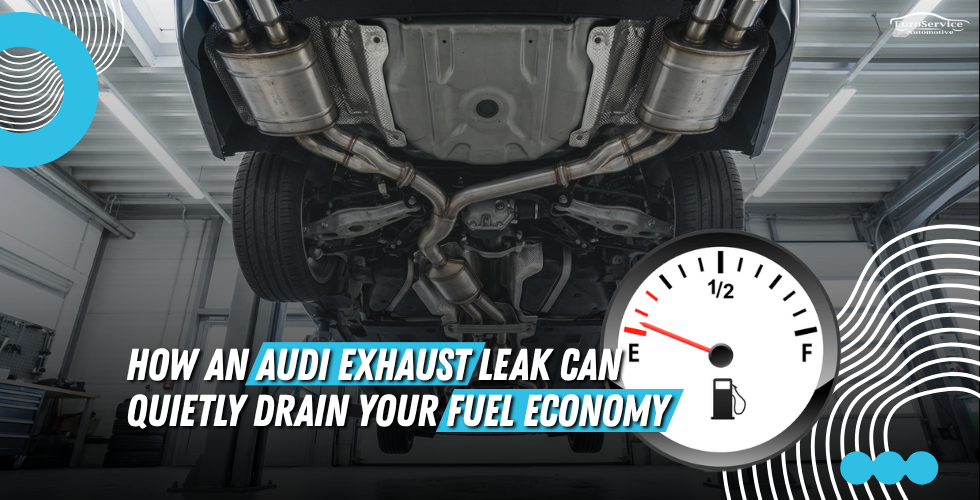
When your Audi starts burning through fuel faster than usual, the first instinct might be to check the air filter or the fuel injectors — and those are reasonable places to start. But one frequently overlooked culprit is a developing exhaust leak. While most drivers associate exhaust leaks with noise, the performance consequences run deeper than sound. At EuroService Automotive in Warrenton, we regularly see Audi owners who’ve accepted gradually worsening fuel economy as normal aging, not realizing an exhaust leak has been quietly undermining their engine’s efficiency for months.
How the Exhaust System Affects Fuel Efficiency
The exhaust system does more than route combustion gases out of the engine — it’s an active participant in fuel management. Modern Audis use upstream oxygen sensors (pre-catalytic converter) and downstream oxygen sensors to measure the oxygen content of exhaust gases. The engine control unit (ECU) uses this data to calculate precise fuel trim values, adjusting the air-fuel mixture on a moment-by-moment basis for optimal combustion efficiency.
When exhaust gas escapes through a crack or failed gasket before reaching the oxygen sensor, atmospheric air enters the exhaust stream at that breach point. The oxygen sensor reads this additional oxygen and misreports the exhaust composition to the ECU. The ECU interprets the signal as a lean condition — not enough fuel being burned — and compensates by enriching the mixture. The engine then burns more fuel than the actual air-fuel ratio requires, and fuel economy falls. This closed-loop compensation is designed as a safeguard, but when fed false oxygen data, it works against efficiency rather than for it.
Symptoms That Indicate an Exhaust Leak in Your Audi
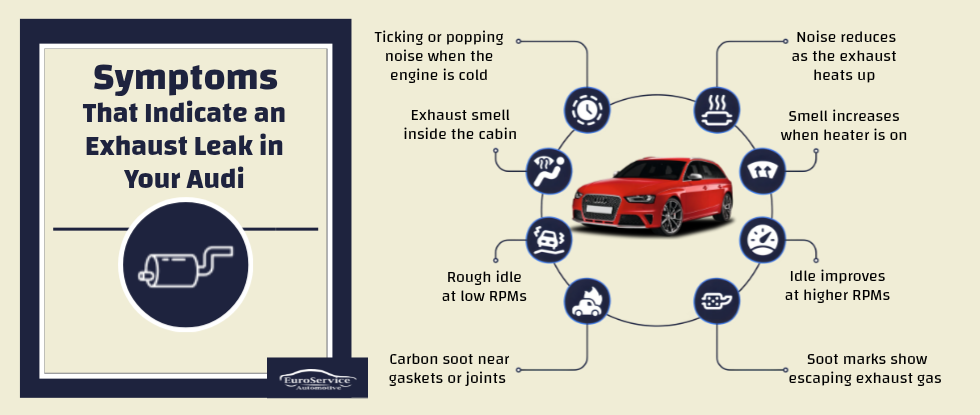
The most common early sign is a ticking or popping sound that’s loudest when the engine is cold and may diminish once the exhaust system heats up and metal expands to partially close the breach. This thermal behavior is a key diagnostic clue — a noise that changes with temperature is pointing toward the exhaust, not the valvetrain or accessory belt.
Other symptoms include a faint exhaust smell in the cabin, especially when the heater draws air through the firewall area, and a rough idle that resolves at higher RPMs when exhaust pressure increases and the leak becomes less disruptive. Carbon soot staining around exhaust manifold gaskets, pipe joints, or flex sections is visible evidence of escaping gas.
The fuel economy impact is often gradual enough that drivers absorb it without alarm — dropping from 26 mpg to 22 mpg over several months doesn’t trigger immediate concern the way a check engine light does. But over a year, that decline adds real cost at the pump and points to a repair that becomes more expensive the longer it’s deferred.
Where Exhaust Leaks Occur on Audi Vehicles
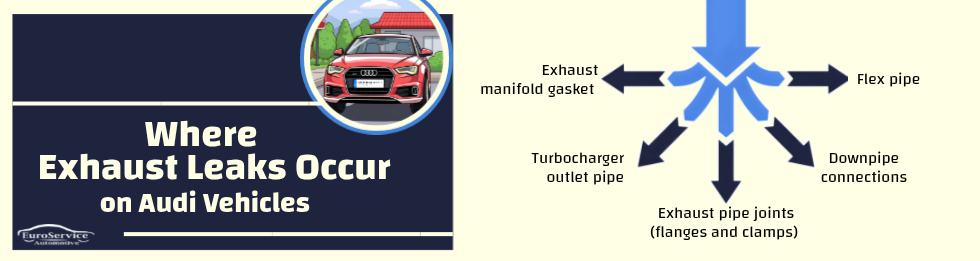
The exhaust manifold gasket is the most common failure point on high-mileage Audis. The manifold bolts to the cylinder head at temperatures that cycle from cold to over 1,000°F in normal operation. This repeated thermal stress fatigues the gasket material and can warp the manifold flange over time, breaking the seal. Four-cylinder engines like those in the A3 and A4 1.8T/2.0T are particularly susceptible to manifold leaks near the central outlets.
The flex pipe — a corrugated metal section designed to absorb engine movement — is another frequent failure point, especially on higher-mileage vehicles. Flex pipes develop cracks at the corrugation folds as the metal fatigues. On turbocharged Audis, the turbocharger outlet pipe and downpipe connections are also subject to seal failure from the added pressure and temperature demands.
Finally, exhaust pipe joints where sections connect with flanges and clamps can leak when the gasket degrades or the clamp loses tension. These leaks are often audible and visible but may be dismissed as minor because they’re not triggering a check engine code.
Diagnosis and Repair at EuroService Automotive
A proper exhaust leak diagnosis involves raising the vehicle, performing a visual inspection under lighting for soot staining and physical damage, and listening under load to isolate the leak’s location. In some cases, a smoke test is used — pressurized smoke is introduced into the exhaust system and the technician observes where it escapes.
Once the leak is located, repair options depend on the severity. A cracked flex pipe or failed manifold gasket typically requires replacement of the affected component. Manifold repairs on Audis sometimes require addressing warped flange surfaces as well, ensuring the new gasket seals correctly against a flat mating surface. Sealant-only repairs on exhaust leaks are temporary and generally not recommended on Audi vehicles, where thermal cycling will quickly defeat any sealant that isn’t backed by a proper replacement gasket.
Contact EuroService Automotive in Warrenton
If your Audi’s fuel economy has dropped or you’re hearing exhaust-related sounds, contact EuroService Automotive at (540) 347-9800 or visit us at 6583 Merchant Place Suite 304, Warrenton, VA 20187. Our ASE-certified technicians will diagnose the issue accurately and restore your engine’s efficiency.
Frequently Asked Questions
Can an exhaust leak cause a check engine light on my Audi?
Yes, though not always immediately. An exhaust leak that introduces false air before the upstream oxygen sensor will eventually produce a fuel trim fault code (P0171 or P0174 for lean condition) and trigger the check engine light. Leaks downstream of the sensor may not set a code but will still affect performance and emissions.
Is it safe to drive my Audi with an exhaust leak?
A small manifold leak is typically not immediately dangerous, but a leak anywhere from the manifold through the firewall area can introduce carbon monoxide into the cabin — especially with the heater running. A leak should be diagnosed promptly, and driving with cabin exhaust smell should be avoided.
How long does exhaust manifold gasket replacement take on an Audi?
It varies by model and whether the manifold flange needs resurfacing, but most Audi manifold gasket replacements are completed in three to five hours of labor. Turbocharged models may take longer due to component access.
Will fixing the exhaust leak restore my previous fuel economy?
In most cases, yes. If the oxygen sensor was reading correctly before the leak developed and the sensor itself hasn’t been damaged by heat or contamination, correcting the leak will restore the ECU’s ability to accurately trim the air-fuel mixture, returning fuel economy to expected levels.