
 6583 Merchant Place Suite 304,


Two quarts since the last service, maybe three, and the pavement under the car is dry every morning. That combination sends most owners down one of two wrong roads. Either they decide the car must be leaking somewhere they cannot see and start replacing gaskets, or they decide BMW engines just drink oil and keep topping it up until something expensive happens.
Both can be true on the same car. Telling them apart takes a measurement, and the measurement should happen before the cold settles in around Fauquier County and short trips become the whole month.
Quick Summary: Key Takeaways
- Consumption and leaks look identical on a dipstick: the only difference is where the oil went, and you cannot tell from the level alone.
- A measured consumption test settles it: fill to a known mark, seal the drain and filter, drive a set distance, measure again.
- Burned oil has a second victim: oil that passes the rings or valve guides goes through the catalytic converter.
- Cold short trips make it worse: a crankcase that never fully warms holds fuel and moisture, and thinned oil slips past rings more easily.
Consumption is a real thing, and it has a real limit
Every engine uses some oil. A film has to stay on the cylinder walls for the rings to seal against, and a share of that film burns on every stroke. Turbocharged engines use more of it because the turbo shaft seals run in oil under pressure, and direct-injected engines wash the bores with fuel on cold starts, thinning what is left behind.
So the question is never whether your BMW uses oil. It is whether the amount matches what the manufacturer allows for that engine, and your owner’s manual carries that figure. Anything beyond that figure is a fault, and the usual suspects are valve stem seals, worn rings, a failed crankcase ventilation diaphragm pulling oil into the intake, or a turbocharger seal.
How a shop proves which one you have
The test is tedious and it is the only thing that actually answers the question. The car comes in, the engine is brought to a known oil level with the car level and the engine at temperature, and the drain plug and filter housing get marked so nobody disturbs them. You drive a defined distance. Then the level is read the same way, on the same ground, at the same temperature.
If the level dropped and the engine is still clean underneath after that distance, the oil left through the combustion chamber or the intake. If the underside is wet, the leak is doing part of the work and the gasket comes first.
Electronic oil level sensors muddy this. They average readings over a drive cycle and report in coarse steps, so a sensor telling you the engine is a quart down is giving you a band. For a consumption test, the physical check wins.
The part of the car that pays for burned oil
Oil that goes out through the combustion chamber coats the catalytic converter. It does not do it in a week, and that is the problem, because by the time the check engine light comes on with a catalyst efficiency code the converter is finished and the original cause is still there.
Those events in that order get expensive. The Clean Air Act sets the emissions warranty on a catalytic converter at eight years or 80,000 miles, whichever comes first, for light-duty vehicles built from the 1995 model year on. That helps if your car is young and does nothing at all the moment it is not. Fixing an oil consumption problem at 90,000 miles is maintenance. Ignoring it is how you end up buying the converter yourself.
Cold months are the worst time to be casual about it
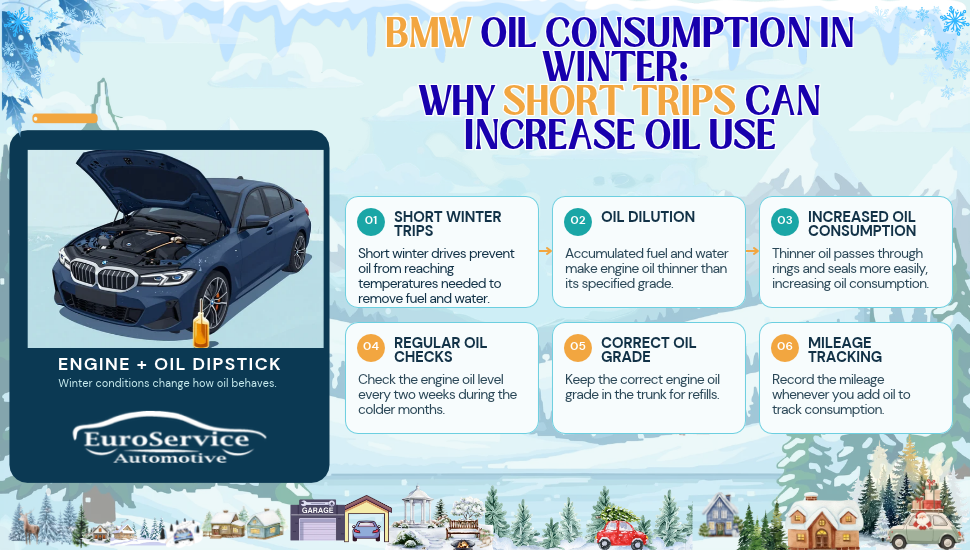
Short winter runs around Warrenton, Bristow and Haymarket never get the oil hot enough to drive off the fuel and water that collect in the crankcase. Diluted oil is thinner than the grade on the bottle, and thinner oil slips past rings and seals more readily. A car that used a quart every 3,000 miles in September can use noticeably more by January without anything new having broken.
The practical move is to check the level by hand every couple of weeks through the cold stretch, keep the right grade in the trunk, and write down the mileage each time you add. That log is the most useful thing you can hand a shop.
Frequently Asked Questions
Q: Is it bad to keep topping up instead of fixing the cause?
A: Topping up protects the engine, so keep doing it. It does not protect the catalytic converter, and that is why the cause still needs finding.
Q: Will a thicker oil stop my BMW from using oil?
A: It can mask it slightly and it costs you cold-start protection and, on some engines, correct variable valve timing operation. Use the grade and approval the manual lists.
We Measure It First, Then Talk About Parts
Your top-up log and the car are enough to start with. We set the engine to a known level, seal the drain and the filter, and read it again after a measured distance. At the end of that you know whether you are looking at a gasket, a ventilation valve, or the engine itself.
EuroService Automotive — 6583 Merchant Place, Suite 304, Warrenton, VA 20187