
 6583 Merchant Place Suite 304,


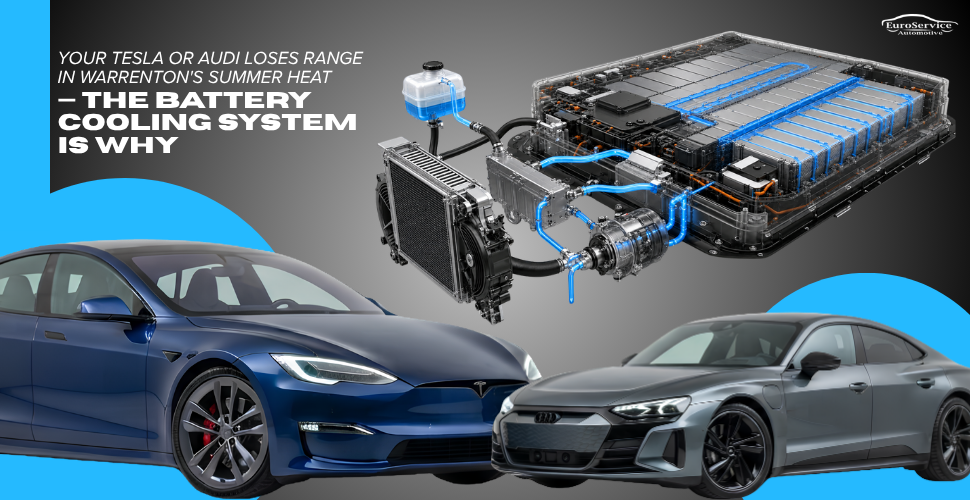
It’s July in Fauquier County, 95 degrees, and your EV shows noticeably less range than it did in spring. You’re not imagining it. Heat is as hard on a lithium-ion pack as deep cold, and the system fighting it — the battery’s liquid cooling loop — is quietly working overtime every time you drive US-29 or sit on I-66.
Most drivers never think about EV or hybrid coolant until something goes wrong. That’s a mistake in a Virginia summer. When the cooling loop weakens, the pack runs hot, range drops, charging slows, and long-term battery health takes a hit. If your Tesla, Audi, or BMW feels down on range, it’s worth a look before the worst of the heat.
Quick Summary: Key Takeaways
- Heat drains range too: EV packs can lose 20–30% of range in temperatures above 95°F, not just in winter cold.
- Batteries are liquid-cooled: German EVs and Teslas circulate coolant through the pack to hold it near 70°F — that loop needs service.
- Fast charging adds heat: DC fast-charging in summer heat stacks two heat sources on the pack at once.
- Watch for slow charging: Reduced charge speed or a hot-battery warning often means the cooling system is falling behind.
- Coolant isn’t forever: EV and hybrid coolant degrades and must be checked and replaced on schedule.
Summer Heat Steals EV Range, Not Just Winter Cold
Most people know cold hurts range. Fewer realize heat does the same. Lithium-ion chemistry is happiest between 68 and 77 degrees, and once ambient temperatures climb past 95, a Recurrent study of more than 7,500 EVs found real-world range can fall 20 to 30 percent. Run the AC hard on a Warrenton afternoon and it compounds.
The pack itself has to be cooled to stay healthy, and the energy for that comes from the same battery moving the car. Heat costs you twice.
German EVs and Teslas Cool the Battery With Liquid, and That Loop Wears
Your battery isn’t air-cooled. A Tesla, Audi e-tron, or BMW i4 runs coolant through channels around the cells to hold the pack near an ideal temperature, using a chiller tied into the AC system and, on many models, a heat pump. It’s a real cooling circuit with a pump, hoses, and specialized low-conductivity coolant.
Like any coolant loop, it ages. The fluid breaks down, flow drops, and air or contamination sneaks in. When that happens, the pack loses its ability to shed heat exactly when it needs it most — a stop-and-go crawl toward Gainesville in August.
Fast Charging in the Heat Doubles the Load on the Pack
DC fast-charging generates serious heat inside the battery, and doing it on a 95-degree day means the cooling system fights charging heat and ambient heat at the same time. A healthy loop keeps up. A weak one can’t, so the car throttles charge speed to protect the cells, and you sit at the charger longer.
That slowdown is a symptom, not just an annoyance. AAA expected to rescue 7.7 million drivers over the summer of 2025, and while EVs rarely overheat on the road, a stressed pack that isn’t cooled properly loses range and long-term capacity you can’t get back.
The Warning Signs Show Up as Range, Charge Speed, and Alerts
Watch three things in summer. Range that drops further than the heat alone should explain. Charging that has grown slower than it was in spring. And any hot-battery or reduced-power message on the dash. Any one of those points at the thermal system.
Hybrids give the same clues. A Warrenton commuter’s plug-in hybrid or an older Prius leans on the same idea, plus a separate 12-volt battery that summer heat kills outright. Different scale, same enemy.
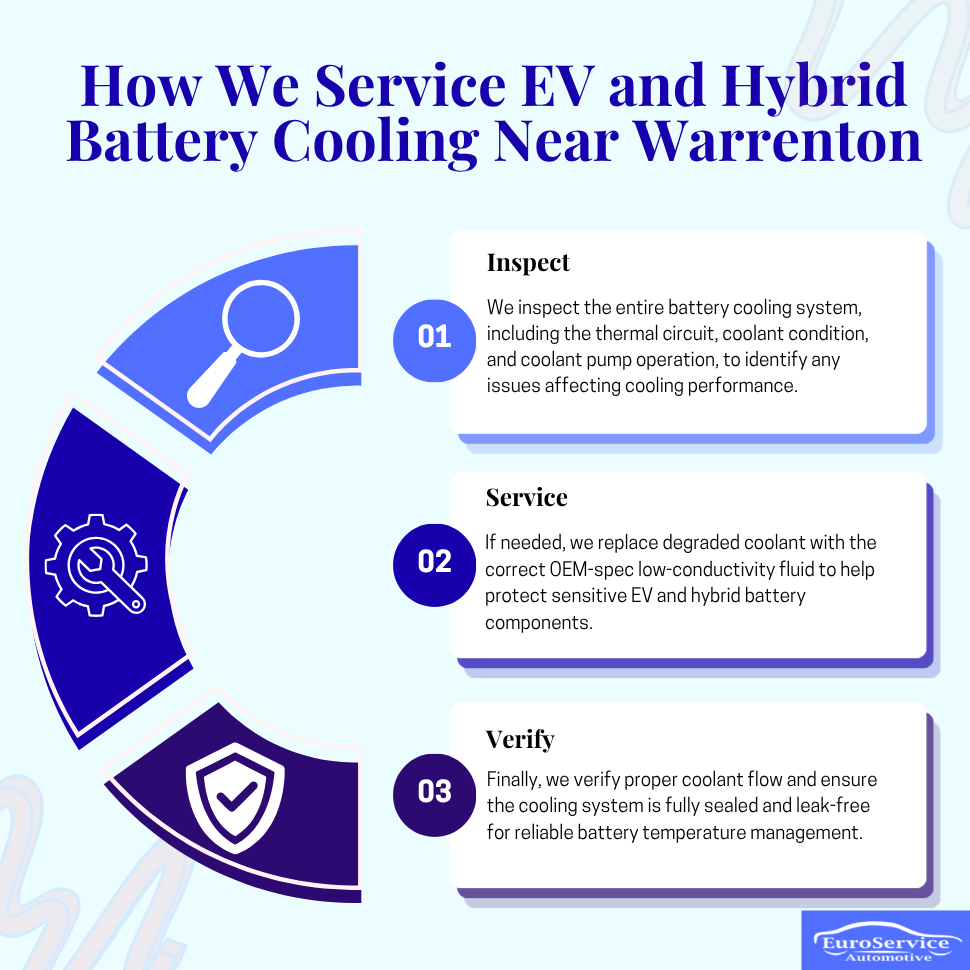
How We Service EV and Hybrid Battery Cooling Near Warrenton
We test the whole thermal circuit, not just the level in a tank. That means checking coolant condition, pump operation, and how well the pack actually holds its temperature under real load on factory-level equipment before we say a word about parts. Then we replace degraded coolant with the correct low-conductivity fluid and confirm the loop is sealed and flowing. No shortcuts.
EVs and hybrids are core work for us, from Teslas to Audis to Land Rovers. Every qualifying repair carries our 24-month/24,000-mile warranty. Bring your EV in before the heat peaks and keep the range you paid for.
Frequently Asked Questions
Q: Does hot weather really reduce electric car range?
A: Yes. Lithium-ion batteries perform best around 70 degrees, and above 95 degrees real-world range can drop 20 to 30 percent as the pack works to cool itself and the AC draws power. It’s a summer effect most owners blame on driving style when the heat is the real cause.
Q: How is an EV battery cooled?
A: Most German EVs and Teslas use a liquid cooling loop that circulates specialized coolant around the cells, tied into a chiller and often a heat pump. It holds the pack near an ideal temperature during driving and charging. Like any coolant system, it needs periodic inspection and fluid replacement.
Q: Why is my EV charging slower in the summer?
A: When the battery gets hot, the car limits charge speed to protect the cells. On a hot day, or if the cooling system is weak, the pack can’t shed heat fast enough during DC fast-charging, so charging slows. Persistent slow charging is worth having the thermal system checked.
Q: Do EV and hybrid batteries need coolant service?
A: They do. The battery coolant degrades over time and by mileage, and low or old fluid reduces the pack’s ability to manage heat. Following the manufacturer’s coolant schedule protects range, charge speed, and the long-term health of an expensive battery.
Have Your EV’s Battery Cooling Checked Before Peak Summer
Seeing less range or slower charging this summer? Let us test the battery’s cooling system before the heat takes a lasting toll.
EuroService Automotive — 6583 Merchant Place, Suite 304, Warrenton, VA 20187
Hours: Monday–Friday 8:00 AM – 6:00 PM; Saturday–Sunday closed
Website: euroserviceauto.com